For years, the development of private label in the beauty sector has been, at best, an exercise in prudence. In many operators, it has bordered on the residual. While food, drugstore, or cleaning have consolidated the distributor brand (MDD) as their main driver of profitability and loyalty, in beauty it continues to occupy a secondary, almost uncomfortable space.
The apparent reason is known: the beauty category is deeply linked to the brand. It is aspirational, emotional, and identitarian. A terrain where historically large manufacturers with unattainable marketing budgets have dominated. But that argument is starting to fall short.
While the sector continues to look the other way, data and some operators are already demonstrating that private label in beauty is not only viable, but can become one of the most powerful strategic levers to combat consumer infidelity.
The opportunity is there; the question is who is willing to capture it.
The consumer has already changed
The first erroneous diagnosis is to believe that the development of the private label depends on the category. It is not so: it depends on consumer behavior. And that behavior has already mutated.
According to Circana, the mass consumption share -except fresh products- was distributed between 51.7% for private label and 48.3% for manufacturer brand. The data is conclusive, but it is complemented by another also recorded by Circana; the year-on-year growth of private labels in 2025 was 6.3%, much higher than that of their rivals marketed with "manufacturer brand" which was 1.4%.
And this does not respond solely to a price logic. The current consumer compares, evaluates, and optimizes. Almost nine out of ten consumers habitually compare prices and seek the balance between quality and cost.
In this context, the private label has ceased to be perceived as an inferior alternative. Today it is, in many cases, a rational and perfectly valid choice. And when a choice becomes rational and recurrent, it becomes a habit.
In models where the commitment is decisive, this habit is evident: nine out of ten clients incorporate private label in their purchase. And it is not about a specific share, but about integration into the consumer's routine.
This is key. Because real loyalty is not built at the moment of purchase. It is built in repetition.
The case that breaks the argument: Mercadona
If there is still doubt about the potential of the private label in beauty, it is enough to observe what is happening in the Spanish market.
Mercadona, through its Deliplus brand, has reached in the last year a 16.2% share in Beauty, which represents four tenths more compared to 2024, according to data from the consultancy Worldpanel by Numerator, the former Kantar.
The key is in a coherent proposal:
- Radically simplified assortment.
- Focus on functional and clear product.
- Own development with quality control.
- Total integration into the shopping experience.
- And, furthermore, implicit prescription within the store model itself.
Mercadona does not compete with brands. It builds its own system. And that system eliminates constant comparison, reduces friction in the decision and turns shopping into a habit.
The big mistake of the sector: copying instead of building
One of the main brakes has been the focus towards economic alternative, many times replicating market-leading products with lower price. This strategy can generate punctual rotation, but does not build value.
The consumer is not naive. They perceive when they are facing a substitute and when they are facing a proposal with identity, which is why the private label cannot be a cheap version of another brand. And this is where the beauty sector has an enormous competitive advantage that it is not taking advantage of: the ability to build its own technical discourse. Ingredients, sustainability, and complete routines.
The terrain is full of opportunities to develop clear and differentiated value propositions. And that demands intention. And coherence.
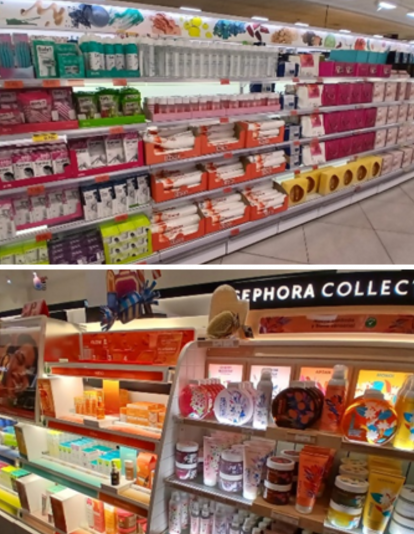
Above: Mercadona. Below: Sephora
From tactical margin to structural loyalty
Another common mistake is to measure private label only in terms of immediate gross margin. Yes, private label can improve the margin. But its strategic value is loyalty.
When a client incorporates a facial, hair, or body care routine based on their own brand, they drastically reduce their exposure to external comparison. They do not need to constantly validate their decision. They do not look for alternatives in each purchase. They simply repeat.
But what's more, in the scenario it operates in, the cost of digital acquisition has skyrocketed and the competition for attention is increasingly greater, which is why this ability to generate recurrence is pure gold. The retailer stops being a mere third-party showcase to become the legitimate owner of the relationship with the customer. And that completely changes the business logic.
The importance of the assortment: less is more
In current beauty, the assortment tends towards obesity. Too many brands, too many promises, too much immobilized inventory. Every novelty from every major brand is accepted for fear of losing a sale, turning stores into warehouses where the customer gets dizzy and the margin bleeds out in references that do not rotate.
In modern retail, excess supply is a form of inefficiency; it generates logistical costs, replenishment errors and, worst of all, analysis paralysis in the consumer. It makes the decision difficult.
Reducing noise is not impoverishing the offer; it is making it more legible. Fewer references, but better selected, generate greater clarity for the consumer and greater rotation for the retailer. A competitive advantage.
The short assortment model explains a large part of the success of the world's most profitable retailers. In beauty, we must learn to select. Private label must occupy a central place, not as a filler, but as the axis around which the rest of the catalog pivots. If your private label is not capable of sustaining your store's discourse, you have a model problem, not a product problem.
Strategic implications for retail beauty
Developing an own brand in beauty is not a tactical decision. It is a model decision. What it implies for the sector:
- Define a clear and differentiated positioning.
- Build coherent ranges, not isolated products.
- Integrate the private label into the store experience, don't hide it.
- Train the team to prescribe it with credibility.
- Maintain quality standards without margin for error.
The private label cannot be a complement to the assortment. It has to be part of the system. And that demands consistency in all touchpoints.
Conclusion: A decision of survival
The private label in beauty does not wait for the consumer; it waits for the retailer. The market has already validated the model and the category allows the margin, but the operational determination to execute it is lacking.
Building an own brand with technical intention transforms sporadic purchase into a blind habit. At that point, the product stops fighting for the penny on the shelf to start defining the business's identity. It is absolute sovereignty over the catalog: margin control, real loyalty, and a coherence that no external brand can replicate.
The success of this strategy is not a hypothesis, it is an efficiency metric. Whoever decides today to be a specialist who edits, will stop being a showcase for third parties to be the owner of their profitability. The time for doubts has ended; now it is a matter of speed and execution.
In the retail of the future, if you don't build your own authority, you will limit yourself to managing the inventory of others.