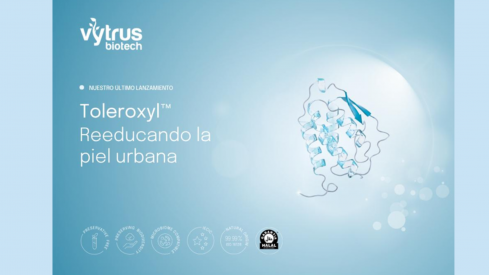
Vytrus Biotech, the company specialized in active ingredients derived from plant biotechnology for skin and hair care, presents its latest innovation at in-cosmetics Korea 2026: Toleroxyl™ - Re-educating urban skin.
Vytrus presents the first cosmetic active designed as a Tolerogen (a new cosmetic category) to help the skin's immune system generate tolerance, instead of simply suppressing visible signs of reactivity.
Toleroxyl™ is a new active ingredient developed through Vytrus' biotechnology platforms. Inspired by the skin's own biological signals, it acts on Langerhans cells (LCs), which are responsible for immune decisions in the epidermis, to help restore immune tolerance, comfort, and visible resilience in urban skin exposed to continuous environmental and indoor stressors.
The innovation will be officially presented at in-cosmetics Korea 2026, where Vytrus Biotech will unveil the concept of immune re-education in cosmetics and the paradigm shift that this new active represents: going beyond soothing, anti-pollution, and anti-inflammatory approaches to advance towards skin tolerance and immune recalibration.
Sensitive skin: a growing category still seeking new answers
Sensitive skin has become one of the fastest-growing consumer concerns worldwide. Modern lifestyles, indoor environments, and continuous, low-intensity exposure to pollutants are contributing to an increase in redness, tightness, burning, stinging, and discomfort. The market often describes skin that "overreacts to everything" or "never stays calm for long," reflecting a deeper biological problem: the skin has not necessarily become weaker, but may have lost its ability to distinguish harmless urban stressors from real threats.
Until now, most solutions for sensitive skin have focused on immediate relief: calming, soothing, blocking, or reducing visible symptoms. However, these approaches may leave the underlying immune imbalance untreated. With Toleroxyl™, Vytrus proposes a new cosmetic logic: training the skin, not just silencing it.
Introducing the Tolerogen: a new cosmetic category
The new active ingredient opens this new category (the Tolerogen) with the aim of training the skin's immune system to develop tolerance. Instead of suppressing inflammation, it educates immune cells to stop overreacting to harmless stimuli.
Toleroxyl™ has been developed to address this biological challenge through a high-precision mechanism based on GM-CSF, a human protein involved in the differentiation, survival, and functional programming of Langerhans cells. These cells play a crucial role in deciding whether the skin responds with inflammation or tolerance.
Produced using plants as biofactories, Toleroxyl™ has been designed from a human signal and is cultivated using a sustainable plant-based recombinant protein platform. This allows for molecular precision, correct protein folding, and a clean and scalable production system, aligning advanced biotechnology with the cosmetic industry's demand for high-performance and sustainable active ingredients.
Re-educating Langerhans Cells for a Tolerogenic Reset
Toleroxyl™ binds to GM-CSF receptors on specific skin cells (Langerhans cells), activating a key cellular signaling pathway that controls immune responses, to keep these cells in a calm state that promotes tolerance. Calm LCs secrete TGF-β, which helps reduce inflammatory signals (TNF-α, IL-8, and IL-6), promoting a healthy, vytrus.com inflammation-free skin environment. By reprogramming LCs towards a tolerogenic state, Toleroxyl™ helps reduce inflammation at its source and restore the skin's natural immune balance. In other words, Toleroxyl™ does not force new biology. It re-educates one that is weakened.
Proven Efficacy for Hypersensitive Skin
Toleroxyl™ has been shown to activate key tolerogenic pathways:
- Restoration of tolerogenic regulators: RELB expression and increased SOX4 reprogram the skin's immune decision-making.
- Resolution of immunogenic markers: CCR7, CD80, and CD86 are restored to physiological levels, preventing overreaction caused by pollution.
- Strengthening of the skin barrier: increased levels of filaggrin, loricrin, and claudin-4 for greater structural resilience.
Clinical studies in volunteers with hyperreactive skin showed the efficacy of Toleroxyl™:
- Reduction of redness and improvement of erythema. • Relief of stinging, itching, burning, and skin tightness.
- In vivo cytokine regulation: clinical reduction of pro-inflammatory markers (IL-8, TNF-α, and IL-6).
Toleroxyl™ opens new possibilities for cosmetic formulation seeking advanced concepts for the care of sensitive, hyperreactive, and urban factor-exposed skin. Its mechanism is applicable to multiple cosmetic areas, including:
- Formulations to train the tolerance of sensitive skin.
- Anti-redness serums and creams. • Daily anti-pollution care and sun care concepts. • Routines to restore skin comfort and strengthen the skin barrier.
- Products for recovery in overstimulated skin.
- Formulas for rebalancing skin living in urban environments.
With Toleroxyl™, Vytrus Biotech introduces a new cosmetic category designed for the era of hyperreactive urban skin. Combining plant biotechnology, recombinant protein science, and a novel tolerogenic mechanism, the company offers cosmetic brands a new way to address sensitive skin: not by masking the signal, but by helping the skin relearn tolerance. Toleroxyl™ – Reeducating urban skin represents a new step in Vytrus's mission to transform plant biotechnology into high-performance, sustainable, and scientifically advanced cosmetic solutions.