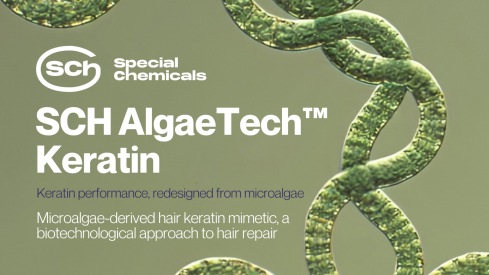
Keratin is the protein that gives hair its shape, strength, and elasticity, and hydrolyzed protein is one of the most sought-after active ingredients in hair care. But most of the keratin used by the industry still comes from wool or feathers, an origin increasingly difficult to fit into vegan, traceable, and sustainable formulas. Until now, plant-based alternatives had a clear limit, as their amino acid profile bears little resemblance to that of the hair fiber.
Special Chemicals has addressed this limit from its root. SCH AlgaeTech™ Keratin does not start from just any protein source, but from the amino acid profile of hair itself, and reconstructs it from microalgae.
A protein designed from hair
Spirulina (Spirulina platensis) and AFA (Aphanizomenon flos-aquae) were chosen after screening six microalgae biomasses, where these two cyanobacteria were found to have the highest protein content, with between 40 and 44% amino acids on dry biomass, and a naturally rich profile in cationic amino acids. But, like almost all non-animal proteins, they are poor in sulfur amino acids. Exactly the opposite of hair keratin, whose resistance depends on cystine, the amino acid that forms the disulfide bonds that hold the fiber together and which bleaching, dyes, and heat progressively degrade.
Special Chemicals has resolved this gap by combining both microalgae, hydrolyzing them to a peptide fraction mostly smaller than 10 kDa and free amino acids, and enriching the hydrolysate with plant-derived cystine, dosed to close the sulfur gap. The result, confirmed by the aminogram of an independent laboratory: 14.3% cystine, very close to the 16.2% of human hair keratin.
The resemblance goes beyond sulfur. Glycine, leucine, and valine are practically at the same level as in hair, and cationic amino acids (arginine, lysine, and histidine, key in affinity for damaged fiber) add up to 11.8% compared to 12.4% of hair keratin. Overall, the profile of SCH AlgaeTech™ Keratin matches about 80% that of human hair keratin, while the microalgae itself provides an extra of alanine, aspartic acid, tyrosine, and methionine.
Controlled cycle biotechnology
Both microalgae are cultivated on the SCH AlgaeTech™ platform, a 3000m² industrial plant with more than 500 production units in closed glass panel photobioreactors and a capacity of 40 tons per year. The system controls temperature, pH, and CO₂ in real-time, ensuring reproducible and traceable biomass, and uses CO₂ captured from other industries as a carbon source, about seven times more CO₂ captured per hectare than a mature forest. The result is an ingredient with a visible footprint: an intense blue powder, a natural signature of the phycocyanin from microalgae, which is incorporated into aqueous systems at a use dose of only 0.1%.
Keys to innovation
- Keratin-mimetic design: ~80% match with the amino acid profile of human hair keratin.
- 14.3% cystine (16.2% in human hair), provided with plant-derived cystine.
- Low molecular weight peptides (majority fraction <10 kDa).
- 100% non-animal origin: cyanobacteria selected by screening and cultivated in closed photobioreactors fed with captured CO₂.
- High use efficiency: recommended dose of 0.1%.
Science in progress
Special Chemicals has already launched the ex vivo efficacy evaluation program of SCH AlgaeTech™ Keratin on bleached hair. The first phase is an FTIR-ATR spectroscopy study, which allows monitoring the state of keratin and the oxidation of cystine in damaged fiber at a molecular level. This will be followed by a broader battery of tests on the hair fiber.
The company will present the innovation on October 6 at the Hair Care International Congress, organized by Beauty Cluster in Barcelona, with the presentation “Microalgae-derived hair keratin mimetic: a biotechnological approach to sustainable hair repair,” by Laia Sallan, technical director of Special Chemicals. The ingredient will then travel to the Innovation Zone of in-cosmetics Asia (Bangkok, November 3-5), the first stop on its journey through upcoming industry trade shows, where the company plans to announce the first efficacy results.