
Everyday Gesture and Initial Contradiction
The paradox begins with a gesture we repeat countless times a day: swiping on our phones, choosing what we "like."
For years, we've championed a discourse calling for more realistic representation of beauty in the media, and then, two seconds later, we give a like to a flawless face. Hypocrisy? Not quite; we could talk about an unresolved tension between what aligns with our values and ideals and what, without realizing it, aesthetically appeals to us. What is beauty? I'd tell you that everyone has their own idea of what beauty is, but what defines it? Beauty could very well be an agreement between culture and biology, between personal interpretation and contextual influence.
Biology and Fluency
We can even find a rational explanation. The brain appreciates ease, in all aspects. The Aesthetic Pleasure Theory of Processing Fluency explains it: the easier a stimulus is to process (symmetry, proportion, smooth skin, harmonious colors), the more we tend to judge and label it as "beautiful." Without delving into ethical valuations, it's not that it's better, it's that we are configured to process it better. Beauty, in this sense, is also energy economy. And if we add to that that the "prototypical" (statistically frequent or harmonized features) tends to be more familiar, we understand why certain faces seem "correct" almost automatically. The familiar reassures; what reassures, attracts.
History and Halo Effect
But culture doesn't stay on the sidelines. Hegemonic beauty functions as a language of status: we all understand it, whether we like it or not. Here two forces come into play: the "halo effect" (if someone is attractive, we attribute more positive qualities to them) and social comparison (we look at others to calibrate ourselves). The *halo effect* has ancient roots: from Greek *kalokagathia* to the Christian imaginary. **The West associated beauty with goodness**; today social psychology gives that name to the bias. The Philosophical Root: *kalokagathia*In classical Greece, *kalokagathia* united the beautiful (*kalos*) and the good (*agathos*): it was not just appearance, but an ethical ideal. **Proportion and symmetry were understood as signs of order and measure**, a way of saying that an aligned body expressed a world in balance
With medieval Christianity, beauty was read as a reflection of divine perfection, and the deformed was sometimes associated with sin, illness, or disorder. That equation became fixed in the popular imagination: the luminous as a sign of virtue; the irregular, of threat.
We continue to drag that inheritance. Social psychology calls it the halo effect: we attribute moral or intellectual competencies to those who fit the canon. Biology adds a nuance with the so-called behavioral immune system: a tendency to avoid signals that we interpret, sometimes erroneously, as risk. What began as self-protection can transform into moral judgment.
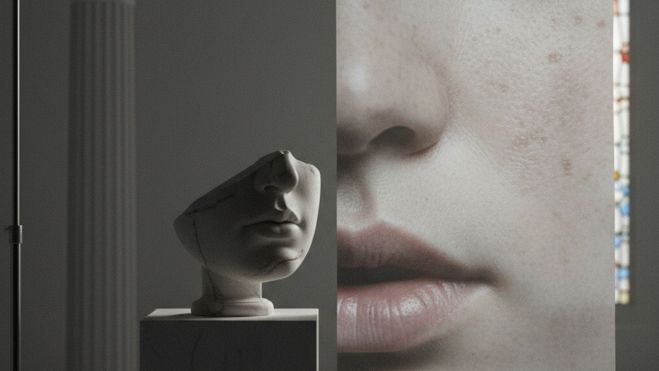
Algorithms and aspiration
On social media, this becomes a vicious cycle: we reward those who embody the beauty canon with attention because they represent a small hit of aspiration, a promise. How do we reward them? By hitting the "follow" button. And that attention translates into economic value, and the system gives us more of the same.
So it's all biology and market? Not exactly. There's another layer: aspiration as personal narrative. Looking at those who embody the ideal isn't just desiring their face; it's desiring their life. Beauty operates as a symbolic shortcut to "success," "control," "security." I'd like to say we're above it, but I have to admit I also save images that are simply pretty to my favorites
The contradiction
Then comes the contradiction: we ask to see pores, wrinkles, body hair, diverse sizes… And at the same time, with our clicks, we elevate what is furthest from that. Incoherence? Perhaps. But in our defense, I will say that it is a human response. **One part of us seeks recognition: "I want to see bodies like mine," and another seeks aspiration.** It is not easy to reconcile them. Furthermore, what we see on our screens, what we are exposed to for hours, is not neutral: algorithms amplify what already captures attention. If the canon functions like a magnet, the system will work to keep it that way
There are theories that help understand why aspirational content continues to be successful. Certain physical appearances communicate resources (time, money, discipline, access). Canonical beauty, when created through aesthetic treatments, time, and touch-ups, conveys a message: "I can afford it." And that message, in unequal societies, is very powerful.
Slow inclusion
That's why real inclusion is a slow process. And yes, along the way there will be days when we retreat to the safety of the canon. It's okay. The important thing is not to deny the attraction to the hegemonic, that would be denying something quite human, but to relativize its centrality.
And how to live with the paradox without turning it into guilt? I wonder if the answer lies in accepting that we want different things at the same time. I can follow a perfect celebrity for pure aesthetic pleasure and, at the same time, ask brands to distribute the spotlight more fairly.
Just a side note: as of January 27, 2026, while we call for a more real beauty, millions of people follow an almost unattainable beauty ideal.
Kylie Jenner has 391M followers on Instagram; Kim Kardashian, 353M; Lisa (BLACKPINK), 106M; Bella Hadid, 60.9M; Jennie (BLACKPINK), 89.3M; and Hailey Bieber, 55.7M.
And having come this far, all that remains is for me to acknowledge the power of aspiration and, at the same time, cultivate a closer look at reality that is demanding of the system