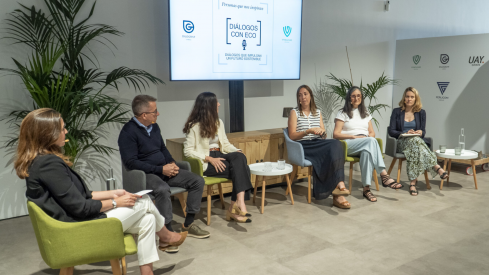
Sustainability has ceased to be a specific or isolated project to become a strategic decision that permeates all business operations. Under this premise, Dilograf Labels, a company of the Ferlicom group specialized in adhesive labels, has held the first in-person meeting of its "Dialogues with ECO" initiative, bringing together a group of leading professionals from the sector at its facilities to share how they are integrating sustainability into their respective organizations.
The meeting was attended by Jordi Aycart, Iberia Supply Chain and Sustainability Director at Nestlé; Esther Villa, ESG Manager at Isdin; Marta Anglada, Impact Director at Laboratorios Ferrer; Cristina Alonso, Non Food and Merchandising Manager at Areas Iberia; and Cinta Bosch, Sustainability Manager at Aecoc. A representation that spans food, cosmetics, pharmaceuticals, travel retail, and sectoral employers' associations, and which allowed for contrasting visions from different points of the value chain.
During the session, five of the major challenges that companies face today in terms of sustainability were addressed:
Sustainability is already part of decision-making. One of the most repeated messages was that sustainability has ceased to depend on a single department to become a transversal axis that impacts the entire organization, from top management to daily operations.
The regulatory challenge. New legislation and the objectives set for 2030 are accelerating business transformation, but they also generate relevant challenges in terms of traceability, reporting, and adaptation of internal processes.
Packaging and recyclability: from commitment to execution. Packaging continues to be one of the areas where difficulties in making progress are most visible. Participants agreed that innovation in this field must necessarily coexist with technical viability, costs, the supply chain, and final consumer acceptance, a particularly sensitive balance for the cosmetic sector where packaging is also a brand tool.
The consumer enters the equation. Although the demand for sustainability grows steadily, a gap persists between what the consumer declares and the purchasing decisions they ultimately make, a gap that brands continue to try to close.
Collaboration as an acceleration engine. The great consensus of the meeting was that current challenges cannot be resolved in isolation. Collaboration between companies, suppliers, administrations, and consumers is emerging as the most effective way to advance faster and achieve a real impact.
This first "Dialogues with ECO" meeting was born with the aim of becoming a recurring space to share experiences and learning around sustainability.