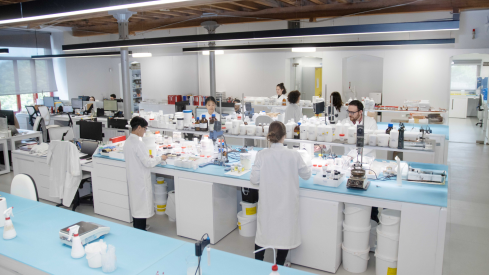
The Centre for Technological Development and Innovation (CDTI), a public entity attached to the Ministry of Science, Innovation and Universities, has approved aid of more than 800,000 euros to finance the research project on new depigmenting active ingredients being carried out by Bella Aurora laboratories.
CDTI supports the brand for the second time in this area, after financing the first stage of the project, dedicated to the study of new depigmentation pathways in hyperpigmented skin. Based on these advances, the new research phase now focuses on the development of exclusive depigmenting active ingredients derived from the identified mechanisms.
The CDTI has as its mission to promote innovation and technological development of Spanish companies, supporting projects that present a high innovative component, technical excellence, and potential for commercial application.
"That CDTI bets on Bella Aurora for the second consecutive time is a recognition of our 135-year trajectory investigating depigmentation and, especially, our continuous capacity to innovate in this field", states Sergi Hernández, Fundamental Research Manager of Bella Aurora Labs. "We are not content with perfecting what exists, we constantly seek new ways to offer more effective treatments."
The funding of more than 800,000 euros will allow developing the entire asset research process and evaluating its effectiveness in cell cultures using 3D skin models, an experimental platform that laboratories have been using for more than 10 years to study new depigmenting active ingredients.
Bella Aurora laboratories will develop this project together with pioneering research centers such as Rovira i Virgili University, with whom it already collaborated in the first part of the project, and together with the Gaiker Foundation, a technology center specialized in applied chemistry that collaborates in the development and optimization of the processes of obtaining and formulating the new active ingredients.