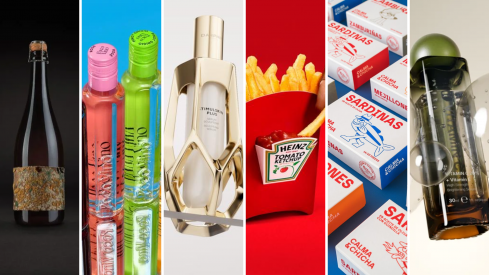
Pentawards, the world's most prestigious competition dedicated exclusively to packaging design, has announced the winners of its annual global competition at the Pentawards gala ceremony, held on October 16 at Magazine London.
The awards organizing body has celebrated 20 years of exceptional packaging design spanning countries from Korea to Brazil.
From labels created by the product itself to formats that rethink the way we eat, drink, play, and unbox. This year's winners demonstrate that the most interesting packaging solves real problems without neglecting craftsmanship and design.
Chloe Scanlan, Marketing Director at Pentawards, explained: "This year's winners perfectly encapsulate the direction packaging design is taking. Across all categories, we see how packaging is becoming a tool to solve everyday problems, becoming part of daily habits and rituals, and reducing waste through clever design and engineering, all while still playing with color and leveraging cultural moments."
Diamond Award: Label created by the wine itself - Piquentum Brut Nature
This year's prestigious Diamond Award has been given to a packaging innovation by Croatian agency Studio Sonda for their work on Piquentum Brut Nature, a wine label made from its own sediment.
Most sparkling wines (over 97%) are made with industrial sugar and artificial yeasts. Piquentum makes its wine naturally and wanted the label to reflect that philosophy.
During the second fermentation, when yeasts convert sugar into bubbles, sediment is generated which is subsequently removed from the bottle using the disgorgement technique. Other producers usually discard it as waste, but Piquentum's sediment was used as a key material.
Mixed with 10% paper pulp from the winery's paper waste, the sediment became the world's first wine label made from the winemaking process itself. The art behind the design lies in how the label continues to evolve. Over time, it forms a noble layer of mold, making it a "living label" and each bottle its own proof of authenticity. By making its label from the wine's own sediment, Piquentum Brut Nature sets a new benchmark, demonstrating that packaging can be made entirely from what would otherwise be wasted, with circular design at its core and losing none of the craftsmanship.
After winning the Diamond Pentaward, creative director Jelena Fiškuš and founder Sean Poropat stated: "We are deeply honored to receive the Diamond Pentaward, the highest distinction of the competition. This recognition is the best confirmation of our conviction that true quality today lies in authenticity and a deep respect for the natural process. It shows that there is immense beauty in imperfection."
Suzy Shelley, jury member and head of sustainability and materials at Pearlfisher, said: "What I loved most about this project is that it's beautiful packaging. It's something I've never seen before and it's not only really beautiful, but it's also very innovative."
Platinum Winners
The full list of Platinum award winners highlights the breadth of creativity and design, spanning all continents and sectors:
- Beverages: Poco Vino - Australian Vintage (Australia)
Poco Vino does what it says on the bottle: an individual 187 ml serving in a market dominated by the 750 ml bottle. Drawing inspiration from fast-moving consumer goods, this format turns wine into a product for aperitifs, removing the pressure of having to commit to a whole bottle or choosing "wrong," and is ideal for informal, weekday, and solo occasions. The smaller size reduces waste, while stackable, fridge-friendly displays improve efficiency on retail shelves. Vibrant colors identify each variety, helping shoppers find and compare wines at a glance, and demonstrates that format innovation can drive growth in a conservative category.
"What I liked about this proposal is that it is a very interesting format, it is pleasant to the touch, it is very simple but elegant, and it is also designed for the mass market."
Jury member, Tatjana Dubovina Jokić, creative director at IW Agency
- Food: Calma & Chicha - Mutta (Spain)
Calma & Chicha seafood preserves from Mutta break with Spanish industry conventions to create a more contemporary and accessible product aimed at a younger, international audience. The packaging revolves around two sisters: Calma, a calm and empathetic sardine who fights against injustices in the sea, and Chicha, a fun and eccentric mussel who cannot be held responsible for her actions when hungry. Cheerful illustrations and a playful color palette help the brand stand out from the competition at a glance.
- Body, health, and beauty: Darphin - Stimulskin Plus - Servaire & Co (France)
Darphin - Stimulskin Plus, by Servaire & Co, is a revolutionary packaging system for luxury dermocosmetics. A sculptural metal cage with an openwork design houses a refillable glass core made from 30% recycled material. Inspired by the skin's natural cellular matrix, the packaging translates almost 20 years of research into morphological aging into a distinctive identity for the entire range of skincare products.
"This project not only delivered a high-level execution of product and brand, but also addressed sustainability in a luxurious way that is often very difficult to achieve."
Jury member, Catherine Lee, Senior Vice President of Global Packaging, Design & Sustainability at Kendo Brands, Inc.
- Home, Leisure & Other Markets: Mono-Kinetic: Smart Packaging Collection for Augmented Reality (AR) Devices - Even Realities (China)
Even Realities replaces typical tech packaging with an artisanal paper design. Made from a single material, the box for its AR glasses uses precise V-shaped folds so that when the inner tray is lifted, the four sides retract to bring the glasses to the forefront. The same folding structure protects the delicate lenses from potential drops, without the need for additional padding.
- Brand Identity & Connected Packaging – Platinum: HEINZ Dipper – The Kraft Heinz Company (USA)
The HEINZ Dipper rethinks the fry box based on how people actually eat: by dipping. Modeled after the arch-key shape of the Heinz logo, a pop-out ketchup compartment has been integrated directly into the box, eliminating the need to deal with separate sauce containers when eating on the go. It adds no additional components and turns every fry box into a Heinz brand element at the point of sale.
"For me, the HEINZ Dipper really stood out; what I liked most was that it's a package where graphic design and structure work in perfect synergy. It merged the distinctive elements of the brand and showed how powerful those elements can be when amplified at scale." Jury member, Claire Robertshaw, Global Executive Creative Director at Design Bridge and Partners.
- Sustainable Design Platinum: COMBOX – SANOPACK INNOVATION (Spain)
Takeaway food containers often leak, hide their contents, or use plastics that are difficult to recycle. COMBOX is a compostable alternative that also functions as a communication channel. Thanks to variable digital printing, each box can be unique and display the specific ingredients of each dish, allergens, or seasonal menus, with individual QR codes for campaigns and total traceability. It's mass personalization, dish by dish.
"What I liked most about this is that it doesn't force you to choose between responsibility and functionality: it communicates that it's compostable and no two containers are alike."
Jury member, Sebba Alqetrani, Director of Technical Packaging Engineering and Sustainability at Nutrafol and Professor at FIT / Rutgers.
- Professional Concepts Platinum: NUDE – Abisal Studio (Spain)
NUDE is an ultra-minimalist concept for luxury skincare, combining a heavy-based glass bottle with a soft spherical dropper. While most luxury droppers use plastic collars and caps, NUDE's suction bulb acts as the closure, eliminating them entirely. Fewer parts mean less waste and simpler manufacturing, while the sculptural shape acts as brand imagery, conveying discreet luxury without the need for graphics.