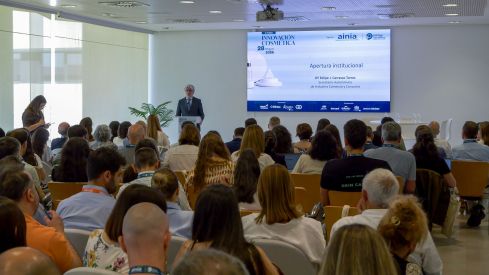
AINIA and the Miguel Hernández University Science Park (PCUMH) have celebrated the IV Cosmetic Innovation Forum, a meeting where more than 150 professionals analyzed how biotechnology, neurocosmetics, and the circular economy are transforming the sector's strategies. The conference addressed the industry's technological responses to a growing market, marked by consumers demanding effective, safe, sustainable products with greater scientific backing.
The forum brought together companies, technology centers, and leading research institutes in cosmetics, and focused on technological solutions with market potential to transform the development of new products from science and the circular economy.
Scientific evidence and neurocosmetics
In the field of neurocosmetics, focused on the relationship between the skin and the nervous system, the forum presented new methodologies to rigorously validate brands' claims or commercial messages. In this technical block, Cristina Codes and Marc Segarra, AINIA researchers, presented some results of the Neurocosmetics project, based on a triple approach: the in vitro cellular study, to understand biological mechanisms; neurophysiological analysis, to measure the body's reactions; and consumer tests, to evaluate the final perception of the product.
The experts explained that the relationship between the skin and the brain is bidirectional and can be measured using scientific tools. As an example, they presented a study in which fragrances, such as mint or lavender, can modify consumers' perception of well-being or state of alertness.
Likewise, Melisa Ortiz, Marketing & Business Development at Antalgenics, addressed the involvement of cutaneous nociceptors in different skin conditions. For her part, Lucía Pérez, Researcher at IDiBE UMH, presented an innervated bioprinted skin model designed to evaluate sensoriality in cosmetic development.
Lucía Pérez has delved into the development of this integrated three-dimensional model, which combines 3D bioprinting techniques with microfluidic systems to promote interaction between human sensory neurons and an advanced mature skin model. This platform allows recreating the nervous dimension of the skin and opens new avenues for studying conditions such as rosacea or pruritus. It can also contribute to evaluating, in a personalized and non-invasive way, the safety, efficacy, and possible allergic response to new cosmetic compounds.
Real solutions in circular packaging
Sustainability has been another of the main axes of the meeting, with the presentation of industrial solutions oriented to the circular economy and applicable to the cosmetic sector. Among them, a successful closed-loop case for post-consumer recycling of packaging has been presented, developed with the collaboration of AINIA and Germaine de Capuccini.
Óscar Rico, Director of Quality Assurance and Sustainability at Germaine de Capuccini, explained this collaborative innovation project, which allows recovering packaging waste from the company itself and reincorporating it into the manufacturing process. The new packaging integrates 15% of material from this waste, maintaining the safety, functionality, and quality requirements demanded of cosmetic packaging.
The initiative shows how collaboration between companies and technology centers allows validating real circular models, in which waste becomes a resource again within the sector itself, maintaining the safety and quality guarantees of cosmetic packaging.
For her part, Melissa Torres, Beauty Business School Director at Beauty Cluster, presented data, trends, and decisions that will mark the future of sustainable packaging in cosmetic packaging.
Biotechnology and solutions for the green transition
The evolution of the cosmetic shelf also involves obtaining more efficient and sustainable ingredients. During the technical sessions, innovations based on peptides were analyzed by Miquel Mulero (Universitat Rovira i Virgili); the application of photophysics to design the topical photoprotectors of the future, by Virginie Lhiaubet (ITQ UPV-CSIC); and the use of PDRN as a biological innovation linked to cell regeneration, a presentation given by Manuela Bermúdez, CSO of QUIMIVITA.
Additionally, the debate around the Blue & Green Beauty trend, moderated by Iván Borrego (IB Corporate Growth), featured the participation of Chema Lagarón (Bioinicia), Joaquim Jover (Jover), Ana Vázquez Santa-Cecilia (Ecoalf Beauty) and Guillermo del Barco (Mediterranean Algae), demonstrating that the reduction of the sector's environmental footprint already has viable proposals based on marine-derived ingredients, resource valorization, and processes aimed at reducing waste.
Innovation to respond to new market demands
The forum has shown that the sector is in a moment of profound dynamism and transformation. The general director of AINIA, Cristina Del Campo, highlighted the sustained growth of a key market for the productive fabric, which forces progress towards models where "well-being, health, sustainability, and digitalization tune in with an increasingly informed consumer."
For his part, Javier Sancho, director of the Entrepreneurship Area of PCUMH, emphasized the role played by the Cosmetic Innovation Forum in fostering knowledge exchange and connecting "the world of science, business, and innovative entrepreneurship." Furthermore, he highlighted the Start-up Pitch Competition, which aims to "give visibility to cosmetic start-ups and encourage new synergies with consolidated companies."
Along the same lines, the regional secretary for Industry, Commerce and Consumption, Felipe Javier Carrasco, highlighted the "emerging and innovative" potential of the cosmetics sector, which triples the average investment in R&D&i in the Valencian Community. "The collaboration between companies, universities, technology centers, and startups has made the Valencian Community one of the most competitive and dynamic cosmetic innovation hubs in Spain," added Felipe Carrasco.
OrAIsi and Kemchain, awarded in the Start-up Pitch Competition
The event concluded with the resolution of the Start-up Pitch Competition, a space dedicated to showcasing the most disruptive proposals from the entrepreneurial ecosystem. The startup OrAIsi was the winner in the Seed category. This RegTech platform, which automates the creation of cosmetic PIF files with artificial intelligence, won the jury's recognition in a final that also competed Aloe Vitae, Dermatologic Store, and IDZ - IngreDiZymes.
For its part, in the Growth category, the recognition went to Kemchain, which shared a nomination with Helseffekt and Raz. This company stood out in the competition thanks to the possibility it offers of transforming the document management of raw materials from suppliers into a simple, fast, and effective process.
In addition to these awards, Next in Beauty presented a prize valued at €600 to each category to be used in the brand's services. The companies Dermatologic Store and Helseffekt received this recognition.
The Seed category recognizes projects in initial phases, while Growth is aimed at initiatives with a greater degree of business development.
The IV Cosmetic Innovation Forum consolidates itself as a key meeting point to strengthen the sectoral ecosystem. Its organization has had the strategic support of its Gold sponsors —Klinea, Qualliance, Moldrug AI Systems, and Ismael Quesada— and its Silver sponsors —Derypol, IDiBE of Miguel Hernández University, Grau, Isobox Systems, and Bioval.