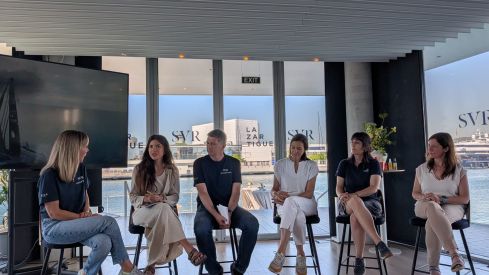
SVR and Lazartigue have held this week in Port Vell of Barcelona, a round table under the motto "Oceans, health and environmental commitment" a meeting that has gathered expert voices from the scientific, health, sports, environmental and industrial fields to address an increasingly urgent problem: pollution by plastics and microplastics and their impact on oceans, biodiversity and human health.
The event has taken place due to the presence in Barcelona of the SVR-Lazartigue trimaran, docked in Marina Port Vell, an enclave that has served as a symbolic setting to open a conversation about the relationship between the sea, human activity and the need to move towards more responsible models.
The round table was moderated by the beauty specialized journalist Katia Rocha under the central idea that plastics are not only a problem of visible waste, but a systemic issue that connects pollution generated on land with water, marine ecosystems, the food chain and finally, people's sald.
The meeting was attended by Irene Antúnez, marine environmental educator of CRAM, who provided a vision focused on the preservation of oceans, biodiversity and the impact of waste on marine fauna: "plastics do not disappear; they fragment into microplastics, persist for decades and end up being incorporated into marine ecosystems and the trophic chain".
Natalia Vía-Dufresne contributed the vision of sport and direct experience at sea and has shared her vision on the visible changes that have occurred in the Mediterranean in recent years, from the increase in waste to the variability of water conditions. Her intervention has highlighted the role of sport as a platform for awareness and as a way to bring the reality of the sea closer to society. Vía-Dufresne has pointed out that "those of us who live close to the sea see how it has changed: the increase in waste and the alteration of water conditions are an increasingly visible reality".
Carlota Bruna, influencer and environmental activist, has been part of this round table to address the social and educational dimension of the problem, focusing on the need to go beyond recycling. During her intervention, Bruna has defended the importance of moving towards an educational model that promotes greater contact with nature and helps new generations to feel part of the natural environment. Likewise, she has reminded that the waste we generate does not disappear and remains for a long time in the environment and continues to have an impact on ecosystems.
Elena Codina, pediatrician specialized in environmental health at Sant Joan de Déu, has provided the health and scientific perspective, focusing on the relationship between microplastics and endocrine disruptors, substances capable of altering the human hormonal system and generating effects on health. Codina has señaldao that increasingly work is being done from this approach to address certain pathologies and accompany changes in patients' habits.
The industry's vision has been represented by Philippe Casara, General Manager of SVR and Lazartigue, who has explained SVR's commitment to reducing the imapcto medioambiental of the cosmetic industry. Casara pointed out the importance of working with the entire value chain "the industry has the responsibility to reduce its impact, innovate in more biodegradable formulas and move towards more sustainable packaging and plastic alternatives".
During the debate, the participants agreed on the need to address this problem from a One Health approach, which understands human, animal, and medoambiental health as deeply connected dimensions. Under this perspective, protecting the oceans can no longer be considered solely an ecological issue, but also a public health priority.
The day closed with the common message that the pollution generated on land, ends up reaching the sea, and plastics fragment into microplastics, present in water, food, marine organisms and even the human body.