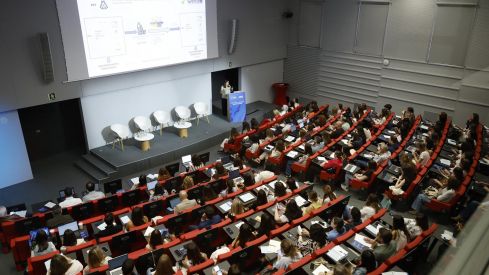
On May 21st, Barcelona hosted the second edition of the Spain Cosmetic Ingredients Regulatory Summit 2026, organized by Beauty Cluster and AEIC. The event gathered more than 200 professionals from the cosmetic sector, including executives, experts in regulation, formulation, R&D, technical control, and quality, consolidating itself as one of the national reference meetings in regulatory matters for the beauty industry.
The event once again brought to the table the major regulatory challenges that will mark the present and future of the cosmetic sector. This second edition stood out especially for the expansion of content and for a structure divided into three major thematic blocks focused on cosmetic ingredients, labeling and packaging, artificial intelligence, fragrances, sun protection, and nutricosmetics. Furthermore, one of the milestones of this edition was to succeed in bringing together the largest number of national associations linked to cosmetics and perfumery.
The institutional opening was led by Gerard Aymi, board member of the Beauty Cluster Board of Directors, and Óscar Expósito, president of AEIC, who highlighted the need to create specialized spaces capable of anticipating regulatory changes that directly impact cosmetic innovation, formulation, and commercialization.
Cosmetic ingredients under regulatory pressure
The first content block, titled “Regulatory Challenges in the Cosmetic Industry: Ingredients”, was dedicated to analyzing the impact of new European and international regulations on cosmetic ingredients.
The first intervention was given by María Alonso, Regulatory Affairs Specialist, Personal Care at Thor Especialidades S.A., with the presentation “Regulatory Framework in which Cosmetic Ingredients Navigate. What Changes Have Marked and Will Mark the Future of Cosmetic Regulation?”. The expert reviewed the five major regulatory areas that currently condition cosmetic companies: Cosmetic Regulation 1223/2009, REACH, sustainability and Green Deal, recycling, and packaging.
During her intervention, María Alonso also presented a timeline with the main regulatory changes foreseen between 2023 and 2028, emphasizing the impact of the Simplification Omnibus VI planned for July 2025.
Next, Ana Cervantes Gutiérrez, Toxicology & Regulatory Affairs Technician at Sigillum, offered the talk “Increasing CMR Substances, Current Situation and Regulatory Challenges”. The speaker analyzed the substances candidates for harmonized CMR classification and recalled that Article 15 of the Cosmetic Regulation prohibits the use of category 2 CMR substances except for a favorable evaluation by the SCCS. She also highlighted the importance of continuously monitoring the regulatory status of these substances to anticipate future restrictions.
Subsequently, Marta Badell, Manager, Technical Services & Innovation PCI at DKSH, presented the paper “Ingredients Under Regulatory Pressure: Risks, Trends and Anticipation”. The session analyzed ingredients subjected to increasing regulatory pressure such as homosalate, titanium dioxide, octocrylene, vitamin A, kojic acid, triclosan or triclocarban, as well as their reputational and strategic implications for formulators and brands.
The block concluded with the intervention of Laia Sallán, Technical Director & Regulatory Affairs Specialist at Special Chemicals, who presented “Beyond the Ingredient: Cross-cutting Regulations that Condition Our Sector”. The specialist addressed issues related to biodiversity, nanomaterials, microplastics, PFAS, certifications and access to natural resources, highlighting how environmental and biotechnological regulations are already redefining the entire cosmetic value chain.
Packaging, labeling and artificial intelligence
The second block of the day, dedicated to “Labeling, Packaging and Artificial Intelligence”, delved into the challenges associated with sustainability, safety and digitalization.
Concha Bosch, Head of the Packaging and Advanced Materials line at AINIA, presented the talk “Emerging Contaminants in Cosmetic Packaging”. During the session, she addressed Regulation UE 2025/40 on packaging and packaging waste, in addition to analyzing emerging contaminants such as NIAS, MOSH/MOAH and PFAS.
Next, Ángela Martín Pobo, Coordinator of the Legislation Group at AIMPLAS, offered the presentation “Keys of the PPWR and the Ecodesign Regulation (ESPR) for the Cosmetic Sector”, focused on the new European requirements for recyclability and ecodesign.
Julia Boras, Sales Manager at Complife, participated with the talk “Cosmetic labeling: regulatory keys for error-free compliance”, where she reviewed legal obligations, frequent errors, and good practices to ensure cosmetic labeling in accordance with regulations.
The block concluded with Maria Mirabet, a consultant specialized in implementing artificial intelligence at a2d Innova, who presented “How the application of artificial intelligence can help the Regulatory department”. The expert showed practical applications of AI to automate regulatory processes, regulatory monitoring, and document generation.
Nutricosmetics, fragrances and sun protection
The afternoon session focused on finished product, nutricosmetics, fragrances and sun protection.
Sara Domínguez, Quality Assurance Specialist at Derworld, presented the paper “From cosmetics to nutricosmetics: regulatory keys to make the leap”. The specialist recalled that legally the term “nutricosmetic” does not exist and that these products are considered food supplements subject to a completely different regulation than cosmetics.
Next, Germán Castillo, Executive Director at AEFAA, offered the talk “IFRA 52 and 81 allergens update”, focused on substance restrictions, allergen management and new requirements of the IFRA standard.
Laura Hernando, Global Regulatory at CPL Aromas, subsequently intervened with “Latest updates in Fragrance Regulation”, reviewing the most recent legislative changes related to fragrances and CLP Regulation.
Sun protection also held a prominent place during the day. Belén Carazo Hitos, Scientific-Technical Director of Stanpa, presented “Sun protection and cosmetic efficacy: evolution of the European Commission's 2006 Recommendation to improve protection”, focused on the regulatory evolution of sunscreens in Europe.
Finally, Blanca Motos Pérez, Technical Director at ADP Cosmetics, closed the block with “Photoprotection under two regulatory frameworks: EU vs. FDA”, comparing the regulatory differences between Europe and the United States regarding sun filters.
The meeting concluded with a participatory Q&A session with the expert and a round table moderated by Victoria Lovelle, Innovation Manager Cosmetics at Beauty Cluster, and Meltem Kuzu, scientific and communications manager at AEIC.
With this second edition, the Spain Cosmetic Ingredients Regulatory Summit once again highlights its role as a strategic platform to share knowledge, promote specialized networking and anticipate the regulatory challenges that will define the future of the cosmetic industry.