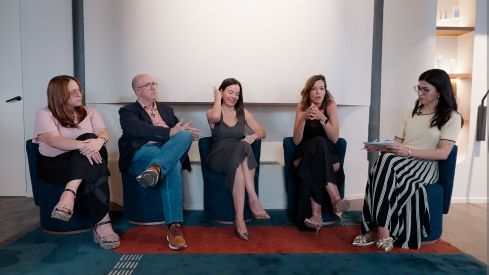
On the occasion of International Sun Protection Day, the brand celebrated a round table at Juno House with experts in dermatology, pharmacy, sun evaluation, and cosmetic formulation to address one of the category's major challenges: translating science to the consumer in a context of overinformation.
Sun protection today lives a paradox: there has never been so much scientific innovation in formulation, textures, efficacy, and adaptation to different skin types, but neither has there been so much confusion surrounding its use, its safety, and its true role in skin health. In an environment marked by overinformation, contradictory messages, and constant debate on social media, the category faces a key challenge: regaining consumer trust through science, pedagogy, and transparency.
The meeting, moderated by journalist María Almenar, brought together expert voices from different fields of health, science, and dermocosmetics: Helena Rodero, pharmacist and popularizer specialized in dermocosmetics and hair care; Ana Molina, dermatologist, scientific popularizer, and Communication Director of the AEDV; Ismael Castellà, specialist in SPF evaluation and sun efficacy at Helioscience; and Silvia Cortés, Chief Scientific Officer of Niche Beauty Lab.
During the conversation, the experts agreed on a central idea: the great challenge of photoprotection is no longer just developing more advanced formulas, but ensuring that consumers understand the science behind them and can turn the use of sunscreen into a daily, informed, and sustained habit.
Science, trust, and pedagogy: the great challenges of photoprotection
One of the main topics of debate was the increasing difficulty in conveying clear messages about sun protection to consumers. Concepts such as SPF, protection against UVA and UVB radiation, the real efficacy of sunscreens, reapplication, or the safety of formulas continue to generate doubts, despite being backed by decades of scientific evidence.
Faced with this context, the speakers defended the need to reinforce rigorous and accessible dissemination. Science, they agreed, cannot stay in the laboratory: it must be translated into understandable, useful, and applicable information in daily life. "Today the challenge is not only to formulate better sunscreens, but to help the consumer understand why, how, and when they should use them. Science only has a real impact when it becomes daily habits," said Silvia Cortés, Chief Scientific Officer of Niche Beauty Lab.
The best sunscreen is the one that is used
The round table also addressed how consumer expectations have evolved. Photoprotection is no longer perceived solely as a seasonal product, but as an essential step within the daily skin care routine.
In this sense, the experts highlighted that efficacy does not depend only on the formula, but also on adherence to use. Pleasant textures, invisible finishes, ease of reapplication, and formulas adapted to different skin needs are now key factors for consumers to truly incorporate sun protection into their daily lives.
The conversation thus focused on an idea especially relevant for the category: the best sunscreen is not necessarily the most sophisticated, but the one that the consumer understands, chooses correctly, and uses consistently.
Photoprotection as a health habit
Another focus of the meeting was the need to reinforce sun protection as a preventive habit from childhood. Experts stressed the importance of continuing to debunk myths about sun exposure, correct product application, and the false sense of security associated with certain contexts, such as cloudy days or urban life.
Photoprotection, they recalled, is one of the most important tools to prevent cumulative damage caused by solar radiation and protect skin health in the long term.
Three conclusions from the meeting
- The sun category needs more pedagogy.
- Innovation must be understandable.
- Sensoriality is key to creating habit.