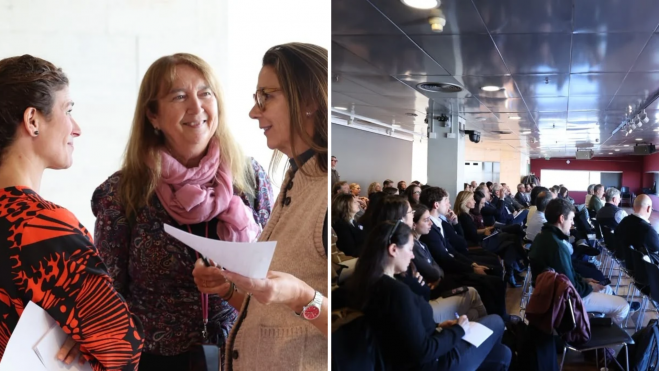
Almost a hundred professionals gathered yesterday in Barcelona for the fifth edition of the People in Beauty Forum at the Centre de Cultura Contemporània de Barcelona. The event, presented by Melissa Torres, director of the Beauty Business School, revolved around the role of artificial intelligence in work environments and how the human aspect and soft skills cannot be replaced by technology, making it necessary to enhance them and learn to relate them to the work performed by Artificial Intelligence.
Salvador Mena, a board member of the Beauty Cluster, was in charge of welcoming the attendees to the event, contextualizing the main theme of the day, and then introducing the speaker who inaugurated the first block with the aim of clarifying the current context in terms of digitalization and artificial intelligence. Ignasi Llorente, from Utopiq.io, emphasized the importance of understanding before implementing, suggesting not to limit oneself to automating traditional tasks. He proposed three scenarios for managing beauty companies: Learning Language Models as new intermediaries, the brand voice in AI, and the augmented professional, which requires rethinking objectives and leadership, and alluded to the need to clearly define the company's culture and know what to ask of AI. Xavi Marlasca, from the Institut Català de la Felicitat, described the role of AI as a kind of apprentice and that humans must be the ones to set the limits and know how to take advantage of it. Subsequently, Núria Vinyoles, from Dribia, took over, explaining that AI requires a selection process depending on the task: regression, classification, segmentation, optimization, generative, or agentic. It only pays off if there is viability, impact, and measurable return. Núria shared real cases and experiences from Danone, Yego, Cloverty, and Ventós, and highlighted the security, control, and quality of the context.
After the interventions of the first three speakers and the coffee break where the speakers enjoyed a space for networking, the day resumed, focusing on the organization. José Navarro, a researcher at the University of Barcelona, explained another challenge that might go more unnoticed: managing motivation in teams. He explained that it is very important to decide how to use the time freed up by artificial intelligence tools and emphasized that it is essential to invest it in aspects that make the organization differentiate itself and grow. Another aspect Navarro wanted to highlight during his intervention was the need to understand that the team is no longer solely human but hybrid, and that a collaborative environment between employees and artificial intelligence had to be created, and that this was important to pivot on four indicators: efficiency, autonomy, trust, and connection. Next, Santiago García from Future for Work Institute, for his part, argues that AI does not determine the future of work, defending that business decisions mediate between technology and employment. He proposes deciding at three levels (strategy, structure, and tasks) with broader criteria than efficiency, and elevating the question "what can AI do" to "do we want to be that organization?".
Subsequently, and with the aim of highlighting what makes us specifically human, the attendees participated in a dynamic that allowed them to connect with each other, expose their most vulnerable side, and also the strengths that make up their professional character. The dynamic was led by Ainhoa Berganza and Ana Guiu, from Inti Coaching, and they wanted the attendees to appreciate what should never be automated; something as genuine as the connection between humans.
To conclude, Jose Manuel Rodeiro presented his RisenAI project to facilitate the pharmacist's task of presenting and recommending products, and he carried out an exercise of synthesizing and integrating everything discussed during the day so that attendees can apply it in their organizations regardless of size and activity.