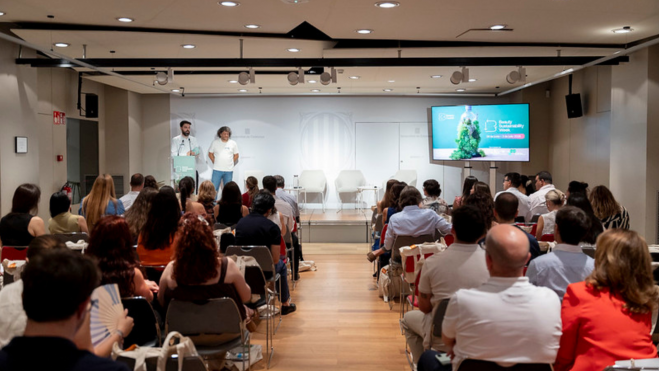
The cosmetics and perfumery sector has an increasingly established certainty: sustainability must be demonstrated. That was the idea shared by more than 80 professionals from the sector who gathered on Tuesday, June 30, in the Sala Cotxeres of the Palau Robert in Barcelona for the Beauty Sustainability Day, the central event of the Beauty Sustainability Week 2026 organized by Beauty Cluster.
During a morning program, critical decisions of the sector were addressed from multiple perspectives: regulatory, technical, and industrial.
A program designed to move from theory to operation
The day began with an institutional welcome by Gerard Aymí, board member of Beauty Cluster, and Adrià Martínez, from Beauty Cluster, and was structured into five thematic blocks.
The first dealt with the new framework of demands: what will be mandatory and how to prepare. Yolanda Martínez (Marimón Abogados) and Mariano Lesser (Blomon) opened the regulatory debate, focusing on the upcoming regulatory milestones that will affect the industry.
Next, the topic revolved around how to demonstrate sustainability: metrics, traceability, and reporting with Ainhoa Salcedo and Laura Vallvé (Provital), Daniel Subirana (CAAE), and Jordi Oliver (Inèdit) who debated, moderated by Anna Escribano, CEO of Rafesa, about the tools companies can use to accredit their environmental impact beyond compliance. In this space, it was shared that sustainability can become a real competitive advantage for the beauty sector, beyond regulatory compliance and reporting, as well as becoming a driver of innovation, transparency, and long-term value for the entire industry.
After the coffee break, it was time to talk about ecodesign in formulation and demonstrate that the alternative is viable with Maria Matesanz (Quimivita) and Ariadna Simón (Croda) analyzed, with Marta Peraita (Izzon Lab) as moderator, how to bring ecodesign to the field of cosmetic formulation.
In the fourth block, the focus was placed on conventional companies and organizations vs. born sustainable: real decisions that mark change. Drolma Lizcano (Alqvimia), Luz Toro de Estrada (Cobiosa), and Miguel Ayora (Izzon Lab) shared a table with Sandra Mercé (Dilograf), who acted as moderator. One of the main conclusions drawn from this round table was that there is no single path to sustainability, as each organization starts from a different point, and it was emphasized that certifications only have value when they reflect a real commitment.
The penultimate block of the day focused on sustainability and competitiveness: Inspiring Business Cases. Joan Marc Claramunt (Àuria) and Daniel Sánchez, commercial director of Rafesa, presented real business cases, moderated by Jordi Oliver (Inèdit).
Finally, the day concluded by discussing good practices and synergies between health and beauty. This last intervention included Elisabet del Valle (Onalabs), Montserrat Sala (Medichem), and Mireia Ferré (Dentaid) who decided to focus on success stories related to the health sector, thanks to the collaboration of the Catalonia.health cluster.
Sustainability as a lever for competitiveness
The cosmetics and perfumery industry is undergoing a historical transformation, where sustainability plays a central role in business and legal strategy. This new paradigm demands radical transparency, driven by regulations that compel brands to move from narratives to scientific evidence through auditable metrics and the future Digital Product Passport. The current challenge for the sector is to elevate sustainability to the same level of excellence as brand positioning, integrating ecodesign and circularity criteria from product conception to ensure that every package is recyclable and every environmental claim is specific, truthful, and verifiable.
This commitment materializes in an innovation that challenges technical limits to create beauty with purpose and soul. The sector is redefining luxury through "upcycling", transforming by-products from other industries into high-value active ingredients, and through the evolution towards formats such as solid cosmetics, which minimizes the use of water and plastics. Beyond industrial efficiency and decarbonization, the future of perfumery lies in the creation of "shared value", where ethics in the supply chain and social inclusion are integrated into the business model. The ultimate goal is inspiring: to demonstrate that maximum efficacy and sensory sophistication can coexist in perfect harmony with net zero impact, inspiring consumers to be part of a positive change for the planet and people.
The event had the support of Provital, Rafesa, Biogründl, Izzon Lab, the Catalonia.health cluster, the Generalitat de Catalunya and Acció, and is part of the Beauty Sustainability Week 2026, the week that Beauty Cluster dedicates to focusing on how the cosmetic and perfumery industry can move towards real, measurable and competitive sustainability.