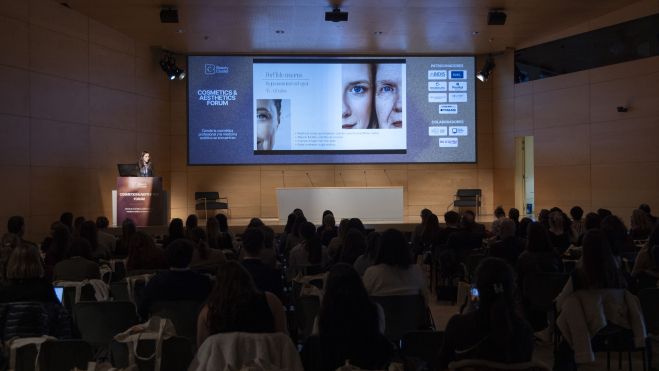
The Beauty Cluster held a new edition of the Cosmetics & Aesthetics Forum, a professional conference that brought together companies, experts, and professionals from the sector to address the major challenges, innovations, and trends that are transforming the relationship between professional cosmetics and aesthetic medicine.
Under the motto “Where professional cosmetics and aesthetic medicine meet”, the event consolidated itself as a space for reflection and updating around an increasingly evident reality: the convergence between both disciplines. In a context marked by the search for more effective, natural, and measurable results, the forum focused on areas such as bioregenerative aesthetic medicine, innovative active ingredients, clinical evidence, nutricosmetics, regulation, non-invasive technologies, and new approaches to profitability and management in aesthetic clinics.
The institutional opening was led by Adrià Martínez, General Manager of the Beauty Cluster, while Victoria Lovelle, Innovation Manager of the Beauty Cluster, was in charge of contextualizing the day with an intervention focused on the present and future of aesthetic medicine. In it, some of the most relevant transformations of the sector were addressed, such as the advance towards less invasive, more personalized treatments oriented to tissue regeneration, as well as the growing role of professional cosmetics as a complement and extension of the medical act.
One of the focuses of the day was bioregenerative aesthetic medicine, addressed by Dr. Eva Álvarez, Global Medical Advisor of ToskaniMED, who defended the need to work from a 360º vision of the patient and to prioritize treatments capable of generating a real improvement in tissue quality. Her intervention brought to the table concepts such as biostimulation, naturalness, sustainability of results, and clinical safety, in line with an evolution of the sector that moves away from more aggressive or artificial approaches.
Body care also had a prominent space with the presentation by Clara Vigo, Omnichannel Product Manager at Provital, who presented a reflection on the new era of body care from the perspective of “dermohacking”. Her presentation linked the growing sophistication of body care with the rise of aesthetic medicine and with an increasing demand for cosmetic solutions inspired by clinical procedures, capable of responding to new concerns related to firmness, contour, and quality of the body's skin.
In the field of active ingredients, Juan Cebrián, Technical Fellow and Marta Vila, Account Manager at Lubrizol, addressed the future of aesthetic medicine from the innovation in raw materials and functional solutions designed to improve visible results and optimize the user experience. The intervention highlighted the growth of the non-surgical aesthetic procedures market and the increasing interest in cosmetic formulas that accompany, enhance, or prolong the effects of treatments.
The dimension of skin self-repair was developed by Lucía Barrera Espino, technical-commercial at EG Active Cosmetics, with a presentation focused on Pantodium Cica and on the role of vitamin B5, the microbiota, and the skin barrier in regeneration processes. The presentation showed how new approaches to the care of sensitized skin or skin altered by aesthetic procedures open opportunities to formulate more specific, tolerable, and effective solutions.
Another of the key issues of the forum was the need to reinforce the regulatory and methodological rigor in the field of cosmetics applied to aesthetic medicine. In this regard, Laura Concha Martínez, Research Physician Dept. Clinical Evaluations at Goya Innova, analyzed the regulatory, ethical, and clinical challenges of cosmetic product studies in this area. Her intervention focused on the importance of designing solid studies, adequately differentiating the limits between cosmetic and medical device, and building sustainable and well-founded claims.
After the networking break, the day resumed the scientific thread with a presentation by Dr. María Costa on the role of collagen and its relationship with skin youth. The presentation reviewed the structural importance of this protein in the skin, its progressive deterioration with age, and the different medical and cosmetic strategies aimed at preserving or stimulating its synthesis.
Along these same lines, Raúl Martos, director of Abidis, presented ABIGEN VEGAN SYSTEM, a proposal based on biomimetic collagen fragments and recombinant polypeptides, with clinical evidence in skin matrix and lipid barrier. The intervention reinforced the idea that cosmetics can play a relevant role in post-procedure recovery and in supporting the skin before, during, and after medical-aesthetic treatment.
The most holistic vision of the day came from Anna Sorokina, International Brand Manager at Alqvimia, with a presentation on professional cosmetics oriented towards a more lasting and human aesthetic medicine. Her talk introduced a broader reading of the skin, also connected with emotional well-being, sensoriality, and the balance between science and user experience.
The role of nutricosmetics in dermal quality and regenerative aesthetic medicine was another of the highlighted topics, thanks to the joint intervention of Dr. Sanja Zivanovic, founder of Skin Molecule X, and Dr. Anna Puigdollers, dermatologist. Both experts explained how well-formulated and evidence-backed supplementation can complement dermatological and medical-aesthetic treatments, especially in strategies focused on collagen, dermal structure, and the maintenance of results.
For her part, M. Eugenia Claveria Gabarre, CEO & Founder of Beauty Manifest, defended the idea that professional cosmetics should be understood as an extension of medical treatment, not as an accessory element. Her intervention emphasized the importance of aligning protocols, formulations, and home recommendations with clinical practice to improve adherence, experience, and therapeutic continuity.
Advanced skin renewal also took center stage with the presentation by Marisol Fernández, Research and Development, Training and Innovation Specialist at Anubis Cosmetics, focused on retinoids and chemical peels from a perspective of safety, science, and personalization. The presentation showed how these resources continue to be key tools in professional skin treatment when applied with technical criteria and adapted to individual diagnosis.
In the same block, Elisabet Quintana Cañellas, general director at Pyramide Cosmetics, presented Epidermaluxe, a proposal based on the fusion of peptides and ceramides, while Iwona Beata Duda, Regulatory Affairs Manager at Toskani, addressed the key regulatory issues in advanced aesthetic medicine, reinforcing the need to continue building a more robust, safe, and aligned sector with current regulatory demands.
The afternoon session opened a more business-oriented perspective with the presentation by Eva García, strategic consultant in the financial, real estate, and beauty sector, on business model and profitability in aesthetic clinics. Her intervention analyzed the keys to building sustainable and profitable clinics in an increasingly competitive environment, marked by the professionalization of management, the need to better measure efficiency, and the importance of combining value proposition, loyalty, and operational excellence.
Next, Dr. Bárbara Meléndez Pinazo delved into the relationship between skin and longevity, proposing analysis equipment as an essential tool to improve skin quality from a systemic approach. Her intervention advocated a more integrative vision of aesthetic medicine, connected with health, prevention, personalization, and advanced diagnosis.
In parallel, Maite Albizu, technical and quality manager at Microcaya, presented different non-invasive technologies to diagnose, measure and enhance results in aesthetic medicine. The presentation showed how the incorporation of analysis tools can help to objectify the skin condition, monitor treatments and offer more precise and personalized care.
The application of CO₂ to facial rejuvenation was another of the prominent topics of the program, thanks to the intervention of Sandra González, sales coordinator at Clinipro, who presented Coolifting and its potential within protocols aimed at improving hydration, luminosity, and firmness without recovery times.
Finally, Mariona Jiménez, Medical Marketing Advisor at Selvert Thermal, unveiled Cellular Infusion Therapy, a 360º skin regeneration proposal that served as a prelude to the closing round table, focused on the synergies between cosmetics and aesthetic medicine.
Throughout the entire day, it became clear that the sector is moving towards a more integrated, regenerative, personalized, and evidence-based model, in which professional cosmetics gain prominence as an active part of the treatment and the patient's experience. The Cosmetics & Aesthetics Forum thus once again highlighted the importance of creating meeting spaces between industry, science, clinical practice, and applied innovation.
The event had the sponsorship of Abidis, Innova Goya, Microcaya, Provital, Selvert Thermal, Skin Molecule X and ToskaniMED, and with the collaboration of Next in Beauty, The Beauty Business Magazine, Beauty Business School and Belleza Pro.