Feeling AI4Beauty 2026, organized by Feeling Innovation by Stanpa (FIBS), a cluster promoted by Stanpa to boost innovation and technological and industrial transformation in perfumery, cosmetics, and personal care, and with the support of AMETIC, gathered more than 140 executives, researchers, innovation, technology, operations, marketing, and general management leaders from the cosmetic industry and the technological ecosystem on Wednesday, November 18, to discuss how artificial intelligence (AI) is opening a new stage for an industry where science, technology, creativity, personal care, well-being, longevity, and consumer knowledge converge.
The event, presented by Pipo Serrano, a journalist specializing in innovation and technology, addressed various current topics, such as the future of AI and its social implications, the novelties being developed by various technology companies, as well as real cases of solutions and processes that are transforming the beauty industry globally. In this regard, the industry starts from a solid scientific, technological, and industrial base, with an investment in R&D&i of around 3.4%. This innovative capacity constitutes an exceptional starting point to leverage the potential of AI, whose adoption is already underway: 82% of cosmetic industry companies that participated in a questionnaire stated that they actively use AI or are developing pilot projects for its application (Feeling Innovation by Stanpa sectoral innovation survey, October 2026).
The survey reflects progress among participating companies, with a prominent weight of innovation-leading companies, at a time when AI is moving from experimentation to business adoption. However, it was noted that innovation must reach the entire industry, including SMEs, which represent 84% of the sectoral business fabric, with solutions and strategies adapted to their different needs and levels of technological maturity.
During the opening speech of the day, Val Díez, CEO of the Stanpa and FIBS ecosystem, emphasized that “artificial intelligence is not a future promise, but a decisive lever for the competitiveness and growth of perfumery and cosmetics.” “Joining forces with the technological ecosystem in spaces like feeling AI4Beauty allows us to accelerate this transformation and turn innovation into real impact for the entire sector,” she added.
The meeting also proposed taking the debate beyond immediate operations to reflect on the great dilemmas and horizons of artificial intelligence. The conference “Towards Singularity: A World That Needs a New Social Contract” given by José Ignacio Latorre, quantum physicist, expert in supercomputing and AI, and director of the Centre for Quantum Technologies (National University of Singapore), analyzed the scientific frontier of AI and the ethical challenges that arise from coexisting with non-human intelligences, raising the urgency of articulating a new social contract and preserving human purpose in the face of technological acceleration. “AI is and will be our companion in our affection, our assistance, and our governance. It is imperative to define this immediate future as ethically as possible,” he concluded.
The leap towards agentic AI and the technological revolution
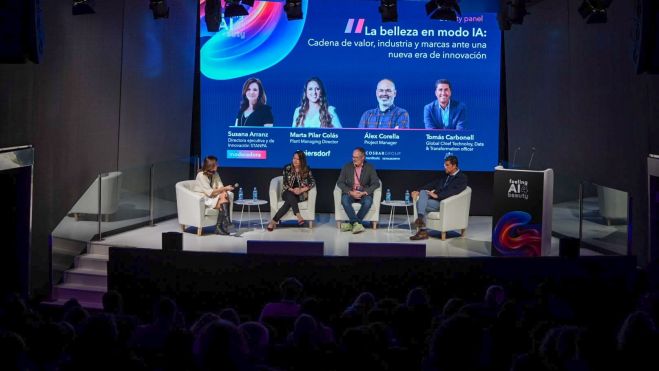
The adoption of AI in the industry has ceased to be the exclusive patrimony of large groups to become a transversal strategic lever, although each company approaches it according to its size and digital maturity. This was evident in the Beauty panel of the meeting, where executives from multinationals and SMEs detailed the real challenges of taking this technology from theory to business. In the industrial field, the focus is on productivity and resource savings. Marta Pilar Colás, Plant Managing Director Manufacturing Tres Cantos at Beiersdorf, explained how the connection of AI with plant management systems (ERP and MES) allows real-time data exploitation to optimize manufacturing flows and reduce energy consumption: “AI allows us to make better decisions and innovate faster, but its true potential lies in how it amplifies the capabilities and talent of our teams.”
For medium-sized companies, the challenge is to innovate without having large in-house technological structures. Álex Corella, Project Manager of Cosbar Group - Montibello, argued that these types of companies can lead an agile adoption if they prioritize specific use cases and rely on external technological partners to gain scale and accelerate results. "The biggest challenge of adopting AI is not only technological, but also knowledge management, governance and, above all, culture and people. The key is to decide what we use it for and ensure that, beyond producing more or being more competitive, it generates a positive impact in terms of well-being and sustainability," Corella pointed out. In parallel, the challenge for a global multinational lies in scaling innovation in complex structures without slowing down operations. Tomás Carbonell, Global Chief Technology, Data & Transformation Officer of Puig, detailed the company's roadmap for deploying a transversal strategy, combining the selection of pilot projects with business impact and a deep management of cultural change within the teams. In this regard, he stressed that "in this transformation, people have more weight than technology, although it may seem paradoxical. Understanding what this new technology brings and where to apply it in the value chain is key to defining the implementation strategy."
This transformation directly affects product development and the relationship of companies with consumers. Kim Dirckx, Chief Digital & Marketing Officer of L'Oréal, in her speech, stressed that technology does not replace the talent of the sector, but amplifies it: "At L'Oréal Groupe, AI helps us turn data and science into innovation, from research and development, to tools that open up new creative possibilities; always combining technological potential with human creativity and judgment."
Secure infrastructures and autonomous agents: the role of technological partners to scale AI
Converting the potential of artificial intelligence into business impact requires overcoming one of the main technical challenges of the cosmetic industry: having secure, interoperable, and scalable data architectures. To accelerate this leap from experimentation to daily operations, the Tech panel brought to the sector the capabilities of technology companies and reference centers such as AWS, Salesforce, Microsoft, and TECNALIA, which showed how to deploy generative AI tools, autonomous agents, and productivity solutions adapted to the real needs of the value chain.
In the area of consumer relations and commercial speed, Mariano Hernández, Retail & Consumer Goods Industry Advisor Director at Salesforce, highlighted the competitive advantage that this collaboration opens: “AI offers opportunities we have never had to interact with customers, anticipate their needs early, and be more agile in our value proposition to the market.” For their part, specialists in cloud computing, productivity, and applied research detailed the keys to sustaining this technological deployment over time. Francisco Lozano Moore, Technical Account Manager at AWS, emphasized that “the technology to scale AI is already within reach of any company, large or small. The difference is in treating it as part of the business and not as an experiment: choosing a specific problem, setting a measurable goal and a date, and having the discipline to scale what works and abandon what doesn't”; while Magda Teruel, Partner Solution Architect and Copilot Champion at Microsoft, remarked “AI first assists us, then helps us create, and with agents, it can take care of complete processes while people set the objectives and review the result. Beauty companies that take this step now will gain speed, judgment, and capacity to innovate." Raúl Miñón, Data and Computation Team Leader at TECNALIA, pointed out that “the true potential of AI in industrial R&D lies in connecting data and scientific knowledge to accelerate innovation. In cosmetics, the next step is to move towards intelligent systems that leverage each test to help researchers make better decisions, always keeping expert judgment at the center.”
Finally, Celestino García, general director of AMETIC, carried out the institutional closing, stating that "the true challenge is to convert artificial intelligence and data into real productivity and competitiveness results for companies. The collaboration between AMETIC and Stanpa demonstrates the importance of connecting the capabilities of the digital industry with the needs of productive sectors to accelerate this transformation."
Best AI Solution for the Beauty Sector 2026, the recognition for the most disruptive technological solutions of the year
Beyond large corporate developments, the entrepreneurial and technological ecosystem demonstrated its ability to solve critical and specific industry challenges in a new edition of the Best AI Solution for the Beauty Sector 2026 award, which saw 11 candidacies. The proposals presented showed how emerging artificial intelligence solutions are already providing tangible answers—both in multinationals and SMEs—, from the mathematical optimization of formulations and the safety evaluation of ingredients, to regulatory traceability, predictive marketing, and dermatological analysis with personalized recommendations.
In this edition, the recognition went to OrAisi Tech, which applies AI to cosmetic safety files, with task automation, integration of regulatory and scientific sources, and expert validation. Along with the winner, the list of finalists included Mafer AI, with a tool focused on a system that seeks to gather and leverage technical formulation knowledge—formulas, tests, analytical data, and regulatory requirements—to facilitate R&D work and accelerate product development. Finally, Nextmol, focused on combining molecular modeling, artificial intelligence, and advanced computing to accelerate the design and characterization of molecules, materials, and formulations, with the potential to reduce tests and resources.