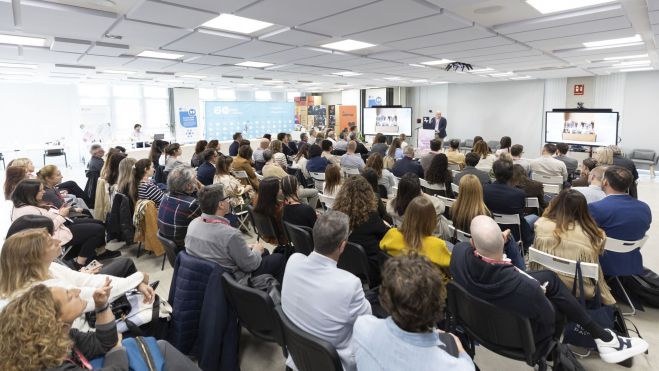
The Beauty Cluster celebrates the first event dedicated exclusively to cosmetic packaging from the point of view of innovation, trends and regulation. The event held on Thursday, April 9, brought together nearly 150 professionals from the cosmetics, perfumery and personal care sector at the headquarters of Grupo TEB, a cooperative with more than 60 years of history that provides employment and resources to people with intellectual disabilities.
The day, which was divided into four blocks, began with the first one focused on rethinking packaging, based on value, purpose, and experience. The intervention of Roger Jérez, industrial business director of TEB, was the first and introduced attendees to TEB's functions and the importance of social inclusion and how this cooperative offers opportunities to all companies and families with intellectual disabilities. Next, Anna Gené, senior designer specialized in packaging at We Are Aktivist explained what the process of designing perfume packaging consists of, responding to manufacturers' requests and following trends, applied in the case of the renowned brand Aristocrazy. Eva Ibáñez, business development director of Encaja Bio/ Milimétrica, and Mariano Lesser, CEO and founder of Blomon, spoke about value, creativity, and efficiency in each link of the chain and gave the keys to being premium while being sustainable and profitable, focusing on life cycle analysis and how to design better. To close the first block of the day, Daniel Sánchez, commercial director of Rafesa, explained the importance of designing packaging with purpose and the role that ecodesign plays here. He highlighted that, currently, the packaging sector faces a great challenge which is to balance four dimensions: design, sustainability, industrial visibility, and premium experience, and that the most common error in the topic of ecodesign always falls on the aspect of regulation, and that it should be seen as a totally competitive advantage, not as a limitation.
The second block focused on innovation, started with the presentation by Àlex Brossa, from the Packaging Cluster, in which he presented the main challenges and trends in packaging and what are the strategic keys for the beauty sector. Àlex Brossa explained that the beauty and cosmetics sector represents approximately between 4 and 5% of global packaging and is the fastest growing and most innovation-demanding sector. Regarding the trends impacting the beauty sector, these are sustainability as a commodity, competition in recycled materials, greater complexity in demand, AI and digital tools, and new business models, among others. The manager of the Packaging Cluster spoke about the materials of the future beauty, such as aluminum, paper and cardboard in substitution of plastic and compostable materials. Another really interesting topic was how the European regulation (PPWR) transforms the rules of the game. Manel Carmona, from Vanguard Graphic, pointed out during his presentation how packaging can become a true sales and brand tool from his experience as ISDIN. Silvia Sabater from ALGLASS and Silvia Hoyos, from Aptar Group, spoke about the evolution from refill to full plastic pumps and how this has become a sustainable revolution in cosmetic packaging. To conclude this second innovation block, Leonor Pascual, from AINIA, spoke about the safe incorporation of post-consumer recycled content in cosmetic packaging applied to a real case in collaboration with Germaine de Capuccini.
After the space dedicated to attendee networking, the third part of the event, focused on point of sale and final consumer, began. In this block, Jordi Calduch, general director of Sampling Innovations, focused on the role of sampling and samples and how sustainability relates to the consumer experience, who is more and better informed, with less time, but with greater demands. Calduch explained that it is essential to create a sampling strategy adapted to the channels where they will be distributed (mass consumption, pharmacy, premium…) and spoke about how to design inclusive packaging according to age, strength, or functional diversity. After this intervention, Daniel Saura, from Leca Graphics, presented a practical case related to cellophane and how this material is forced to fulfill another function due to the new PPWR regulation. Rafael González, from Adaequo Group, also presented to the attendees a practical case of visibility in POS, design, manufacturing, installation, and green point recycling, also by Casa ISDIN located in Paseo de Gracia, and how in these facilities the different elements have been reused in various campaigns that have been held. To conclude the individual presentations, Ramon Gargallo, from Visibilidad Punto de Venta, spoke about design in retail beauty today, from product display to brand experience, and how retail beauty is undergoing a transformation where the focus is on experience. The store now goes from being a point of sale to a space for consumer experience and discovery, and interaction with the product is prioritized. Therefore, Gargallo highlights that displays are key at the final point of decision and purchase activation, allowing products to stand out, communicate benefits, and structure categories.
To conclude the last block, Maica García, from News Packaging, moderated a round table together with Francesc Morata, from Noreste Estudios, Àlex Brossa from the Packaging Cluster, Anna Escribano from Rafesa and Jordi Calduch from Sampling Innovations.
The event concluded after two in the afternoon with a tour of TEB's facilities where attendees were able to discover TEB's way of working and the weight that the cosmetic sector has within the group.